As a trainee teacher with a light timetable I became used to the process of reflecting after a lesson. Unpicking *why* a particular lesson went badly went some way to avoid the same thing from happening again. Did the students become behaviourally disruptive because the task was too hard? Too easy? Could I have scaffolded or modelled that task more carefully?
As a trainee I also found time to reflect on things that went well, in an attempt to replicate the positive as often as possible. However, as I became more experienced time has naturally became more squeezed. I’ve had to spend more time *doing* things and had less time to think/reflect about how things have been going.
This blog is an attempt to help me to pause and reflect *why* things have gone well this week and what I can do to keep this up for both myself and my mentee. My reflections are below:
- Honeymoon period. Rules haven’t been tested yet.
- This is my third year at the school. Students know me. They know that I know what’s up. This is powerful; I’m not a new face & I’m trusted around the school. Most students might have heard of me & heard other students talk about my lessons. This proves that I *can* teach, *will* teach and trust is already built before a new student enters my classroom. This immediately makes it easier for me to enforce routines and establish expectations. Once routines and expectations have been set; that’s half the battle won.
- I’m well rested after the summer. Being well rested means that I’m positive, enthusiastic and have the energy to show this to my classes. Because I’m positive & enthusiastic this makes my students feel more positive & enthusiastic. Because they’re more positive, they enjoy the process of learning more & this makes me happy. I’m now happy & show this to the class. Because I’m happy this makes the class more happy. See where I’m going with this? It’s a positive feedback loop & me and the class are feeding off each other’s positivity. What perhaps I can learn from this is that should a “negative” feedback loop occur within the class then I can halt this slide with an injection of energy of positivity. Perhaps.
The idea of feedback loops then got me reflecting on well…reflections and the point of them. As I wrote in my previous blog post, I’m a mentor now & in the position of encouraging my mentee to reflect as routinely as possible.
Most readers are probably familiar with Kolb’s learning cycle or something similar. I’m a physicist though so I’m robustly sticking with the idea of a feedback loop (which is where I believe the concept of the learning cycle was first borrowed – from electrical engineering).
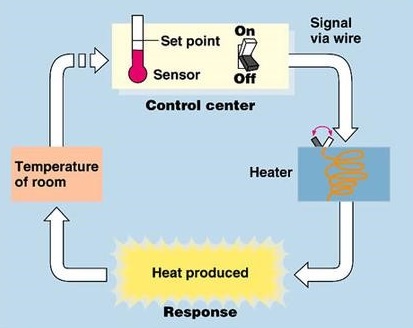
The above image shows one of the simplest feedback loops; the thermostat. A thermostat works by firstly detecting the temperature of a given room. Is the room too cold? If so, then a signal is sent via wire and this is used to close a switch thereby turning a source of heat on. The temperature of the room then increases until it reaches a pre-determined set-point at which point the thermostat opens the switch connected to the heater, therefore removing the heat source.
The thermostat is continuously *learning* from the surrounding environment and making changes to keep the temperature of the room at an optimal level.
This is, in essence how I feel effective teaching should work. Let’s say I pitch the level of the lesson too high & without sufficient scaffolding for the students to get to this high level. This means that the room is too *hot*. We are the thermostat; we learn from our surrounding environment (the lesson that is pitched too high) and to remove the “heat” from the classroom we either pitch the lesson at a lower level or, more ideally, apply some scaffolding to allow the students to reach the high level.
In this way, through trial and error, we can achieve the optimum “temperature”* in the classroom and I will be encouraging both myself and my mentee to reflect as much as possible on lessons this coming year. Judging by the first few days, I’m hoping it will be a good one!
*there is no such thing as optimum temperature in the classroom. It is always too hot or too cold and, mysteriously, sometimes both too hot *and* too cold simultaneously.

 Science Doctor